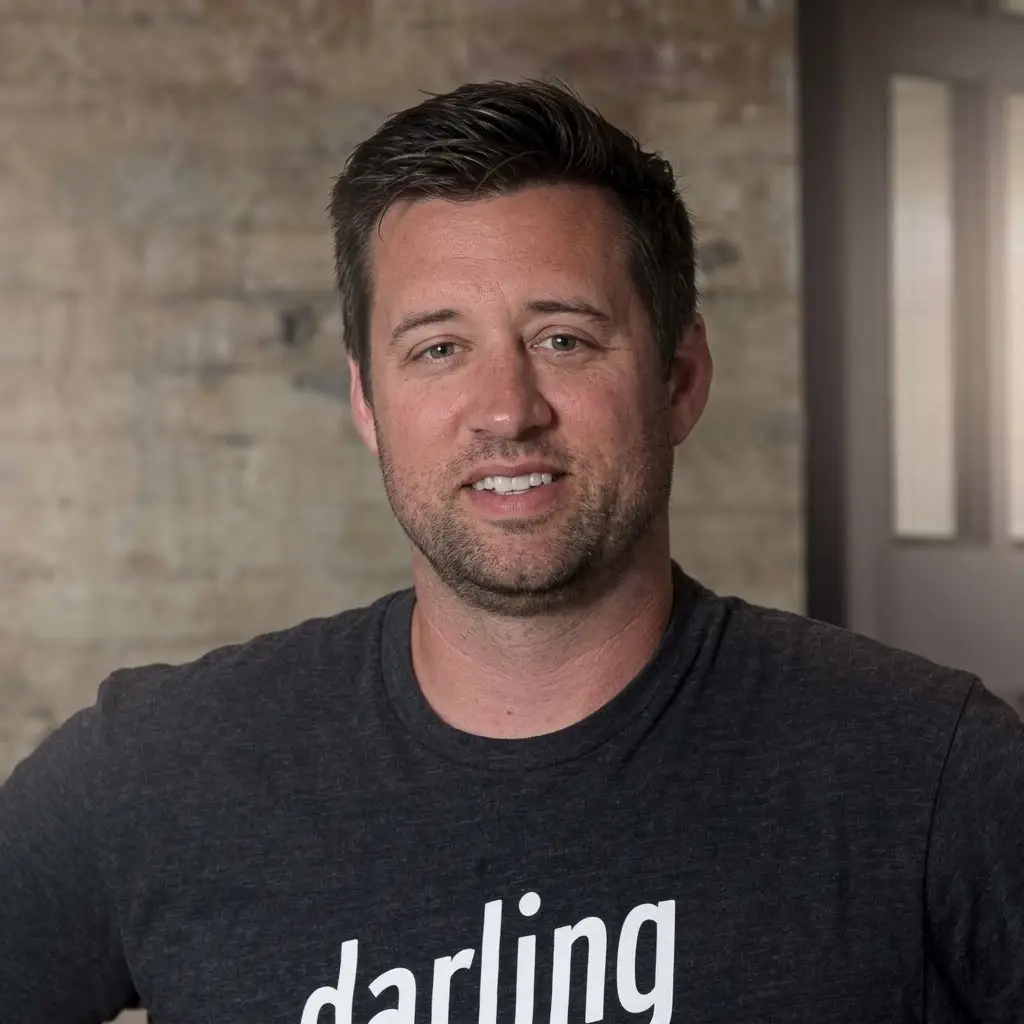
Jake Edinger
Jake Edinger, Writer / Founder · Darling
“It felt like we were onto something, even if we weren't sure what it was.”
Your LinkedIn title says “Writer / Founder.” Not CEO, not Creative Director. At an agency you started, you could call yourself anything. Why “Writer”?
When we first opened, we called ourselves Darling Makery because we believed in getting things made. We still do. And while we always hoped we would grow, we didn’t have a large client to build around. So we pitched ourselves as a bolt-on to internal creative teams and a project shop–almost like a three-person freelance team. And yeah, without a large apparatus around us, we thought we might come off a little too big for our britches if we called ourselves Chief Executive anything. Perhaps we overcorrected. And who knows? Maybe we’ll get a promotion one of these days.
You went from Group Creative Director at HLK, a 400-person agency with decades of history, to starting Darling from nothing in 2017. There’s a gap between having a department under you and having nothing under you. What was the first year actually like?
The first year was amazing. We were borrowing space, building out our new office, assembling cheap furniture. Our expenses were low, and we daydreamed a lot in between introductory pitches. When it was just the three of us, Blake Padberg, Peter Rodick and myself, we watched the entire series of The Office, in our office. I think it was our way of making our space feel more lively.
The great thing about St. Louis, at least at that time, was that large companies weren’t afraid to work with small agencies. And other agencies were very supportive of our ambitions. Our friend Annie Castellano asked us to chip on a cool idea she had for the APA Adoption Center. It ended up going viral. That was fun. She invited us to do a project or two with Express Scripts as well. That was a big deal for us.
People like Mike Spakowski of Atomicdust, Joe Leahy of HLK fame, Tim Leon of Geile Leon and even our former employer, Tim Rodgers, were all extremely generous with advice and great stories from their early days. One I’ll never forget was my “exit interview” with Tim Rodgers. He and everyone at R/T, especially Mike McCormick, had allowed me to stick around at the agency while I got my ducks in a row. (Still working on that.) Anyway, I asked Tim if I was making a foolish move by trying to start an agency with a four year-old and our first baby girl still practicing tummy time. Would this be a terrible decision financially? Was this the right time? Without hesitation, Tim said in his very dry, Tim way, “It’s not like they get cheaper when they get older.” Turns out he was right. About that and a lot of other things we’ve encountered along the way. I’m also indebted to Kris Wright who designed our original logo, my wife Toni, who I always called my angel investor for carrying insurance and giving on-demand pep talks when needed and Jason Parks of Barkley, who has referred us to some of our best opportunities, including Toppers Pizza.
But yes, the early days were fun. It felt like we were onto something even if we weren’t sure what it was.
You were President of the St. Louis Ad Club, you’ve worked at Barkley, Rodgers Townsend, HLK. You’ve seen this market from a lot of angles. What’s something about the St. Louis creative scene that people inside it don’t appreciate enough, and what’s something they need to be honest about?
I’m taken by the support. From our early days to now, almost 9 years later, people are willing to meet. They’re happy to collaborate. Our production scene here is incredible. Shops like Coolfire, Bruton Stroube, Electropolis, The Shop, Aligned Media, Antidote, Retriever–and many more–are always game to make something amazing together. I also think we have a massive pool of talented designers for a city our size.
I don’t know if there’s something that I would say is a downside to the creative scene here, but one thing I’ve noticed year after year is when an agency sweeps an award show, those who didn’t win can be quick to dismiss the work as “not advertising” or “gimmicky” or whatever. There’s always something. I’ve heard it when I’ve been fortunate enough to earn recognition, so I hesitate to pile onto those groans. If four or five independent creatives agree that something deserves recognition, that in itself is impressive. Plus, I love to see what other shops are making, so I hope the tradition of gathering our community around our work continues.
In 2021 you bought a building on Cherokee Street, a block known for antique shops, not ad agencies. Most agencies in St. Louis cluster in Clayton or downtown. What made you bet on Cherokee, and has the neighborhood changed how the work feels?
The first thing that attracted us was that we could afford it. We have been entirely self-funded since Day 1, so cost was a big consideration. But it’s also a cool place to work.
I credit Tim Gebauer of Electropolis Studio for introducing us. He’s been the unofficial mayor of Cherokee Street for a couple decades. He shoots, edits, does VO and audio work with us for several of our clients. He’s also one block away, recording independent artists every chance he gets. When he mentioned that he knew about a cool building that would be perfect for an agency, I took the bait.
And he was right. It’s a great place. In 2018, we moved into what was originally a blacksmith shop built in the 1800’s, renting the first floor. (In the right sunlight, you can still read the painted lettering on the north western corner of Darling.) Our landlords, who owned a record store and a coffee shop on each end of our block, lived upstairs. Pokey Lafarge stored his car in our garage while he toured overseas. A few years later, we were growing, and our landlord wanted to sell. He offered us first dibs before it hit the market.
Then our nextdoor neighbor, who owned The Purple Cow Antique Shop, mentioned he was looking for a renter. At that moment, we had just hired Robb Hass as our VP of Media Strategy, and we were needing some more leg room. So, we started renting the Purple Cow. The owner was kind enough to leave his extensive antique garden in the backyard. We just removed a section of fence, and voila, we occupied two old brick buildings with 12-foot ceilings and various eras of upgrades sprinkled throughout.
We’ve done some renovating of our own. The wall in the Purple Cow now proudly displays our logo along with our unofficial mantra, “Proudly located on Cherokee Street and neither coast.” I think we’ll be here a while.
The neighborhood is great. Walkable shops, lunch spots, bars, free parking–and people are always around, whether they’re shop owners or residents. It’s not overcrowded, but it is active and full of character. Come by any time!
Three founders: a writer, an art director, and an account person. That’s literally a textbook agency team. Was that intentional, or did you just happen to know two people who were equally crazy enough to do this?
Yes and no and yes. In retrospect, it makes a lot more sense than it did at the time. But yes, we eventually came to the conclusion that we wanted to be able to take on any project at any size. We needed creative people to make the work, and we needed an account person to make us seem responsive while we had our heads down.
Over time that small team mentality has prevailed. When we added media to our offering and grew our creative, strategy and account capacity, we wanted to maintain the idea that we were all in our work together. Today, we refer to ourselves as a “full-service boutique.” It’s a category we made up to try and convey that clients will have access to those closest to their business while also getting all the core agency services covered by a tight team. That means everyone on our team is capable, client facing and prolific. It’s a fun group to be around. I’m very lucky, starting with the two partners who agreed to jump in headfirst.