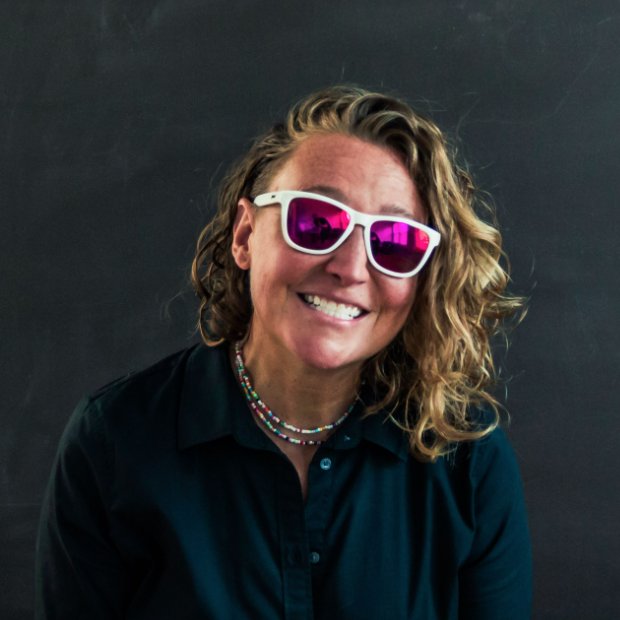
Chris Roettger
Chris Roettger, VP of Illustration · Tremendousness
VP of Illustration sounds like a title you’d have to explain at every dinner party — how do you usually describe what Tremendousness actually does to someone who’s never heard of ‘strategic design and interactive storytelling’?
Illustration is easy, but undersells the work behind the drawings or design. Because we have to jump in wherever our client is, and get up to speed on language (internal and industry-specific) very quickly. I can’t get out of one of those dinner party conversations without saying “I know a little bit about a lot of stuff.” But, ultimately, and most simply we take really complicated or boring or intangible content and make it engaging, accessible, understandable, and (hopefully?) memorable.
Tremendousness is a 6-person shop doing work that sounds like it should require a team of 50 — what’s the thing that only works *because* you’re small?
Yep, we’re small, so that makes us nimble and untethered to laborious internal processes. I say all the time that we’re like a band, everyone is fluent in a range of instruments, so we have slightly overlapping skills (and roles) in the best ways. Add in sincere trust in each other (and earned trust from clients) and we cut through red tape that bigger or more traditional shops might get hung up on. We all help each other do the best work (often in shorter timeframes). That sounds like a pitch, but it is really our daily reality. TBH, small feels good; we’re agile, easily aligned, perpetually optimistic, and willing to work hard and hustle.
Illustration is often treated as the decorative layer you slap on after the real thinking is done — how do you fight that instinct in client work, and do you always win?
It’s not always winning, but finding some kind of joy in the work. FWIW, we don’t consider illustration our most valuable output (even though it is my favorite thing to do). AI and commoditization of graphic services, in general, is really our biggest threat. (sidenote: I keep waiting for the AI fascination to die down and for people to realize it’s absolutely wonderful for cranking out mediocrity in minutes. But real value takes time, and ultimately, that time is better spent with creative thinkers extracting the critical information and making something truly fit for purpose: to move people.)
So, for a few years now, we’ve been leaning on our (creative) problem solving and don’t get tied to a specific outcome. It’s always a journey of discovery and collaboration with the client and we are the tour guides for a very interesting place with lots of possibilities. They may come with a destination in mind, but we show them the landscape of options available and travel there together. Of course we do this through the lens of making something visual and while illustration might be a “layer” that comes together at the end of most of our projects, it’s embedded in the journey and the aesthetic manifestation of that is always tied to the message and the audience.
St. Louis has a weird relationship with its own creative scene — lots of talent, not always the loudest about it. Do you feel like that’s changing, and where does a place like Tremendousness fit into that story?
Is that because we’re all introverts? Or the midwestern nature of work ethic doesn’t always include showing and sharing that work? We gave up our own office space because we weren’t using it much after the pandemic. WFH became too convenient and we got really good at. I feel like a physical community always helps foster a “creative scene.” I like what’s happening in midtown, it feels like a potential hub, but needs more neighborhood support and pedestrian enticement (walkability?), a reason to be there besides work. More, more, more shops, galleries, bars, coffee, etc. And I feel like that’s the story behind a lot of great little creative pockets in St. Louis.
At the end of the day, I think our community’s ability to work with open doors would mean a better collective; I’m just not sure how to do that when we’re all so spread out. Design Week does a great job opening those studios and spaces (dispersed as they are) and it would be great to carry some of that momentum past that one week. Because STL is a big small town, and the more we all work together, share experiences, the better we collectively become. But doing that feels like a full-time job (or two or three?) to figure out and get to a more outwardly recognizable creative scene.
What’s a project you’ve worked on that looked simple from the outside but was genuinely, absurdly complicated to pull off?
All of them? No, not really. But we are often called when our client has a mess of spreadsheets, disparate presentations and docs, data, or just a “problem” and (as I said above) we roll up our sleeves and work with them to figure out how to put it out in the world. Projects like www.stl2030progress.com are complicated simply because the final experience shouldn’t feel complicated. For this project, our team (led by Susanne LeBlanc) wrangled a huge amount of interconnected data; charts, projects, initiatives, priorities; and organized it into something people could actually navigate and understand.
Good design in this kind of work is mostly invisible. Nobody notices when navigation works exactly like it should or when information feels intuitive to explore. They just find what they need and move forward. Usually, bad design is the thing people notice. That’s the hard part of the work; all the thinking, organizing, and simplification happening beneath the surface to make something complex feel clear.
Chris Roettger
Chris Roettger, VP of Illustration · Tremendousness
Boring Questions